
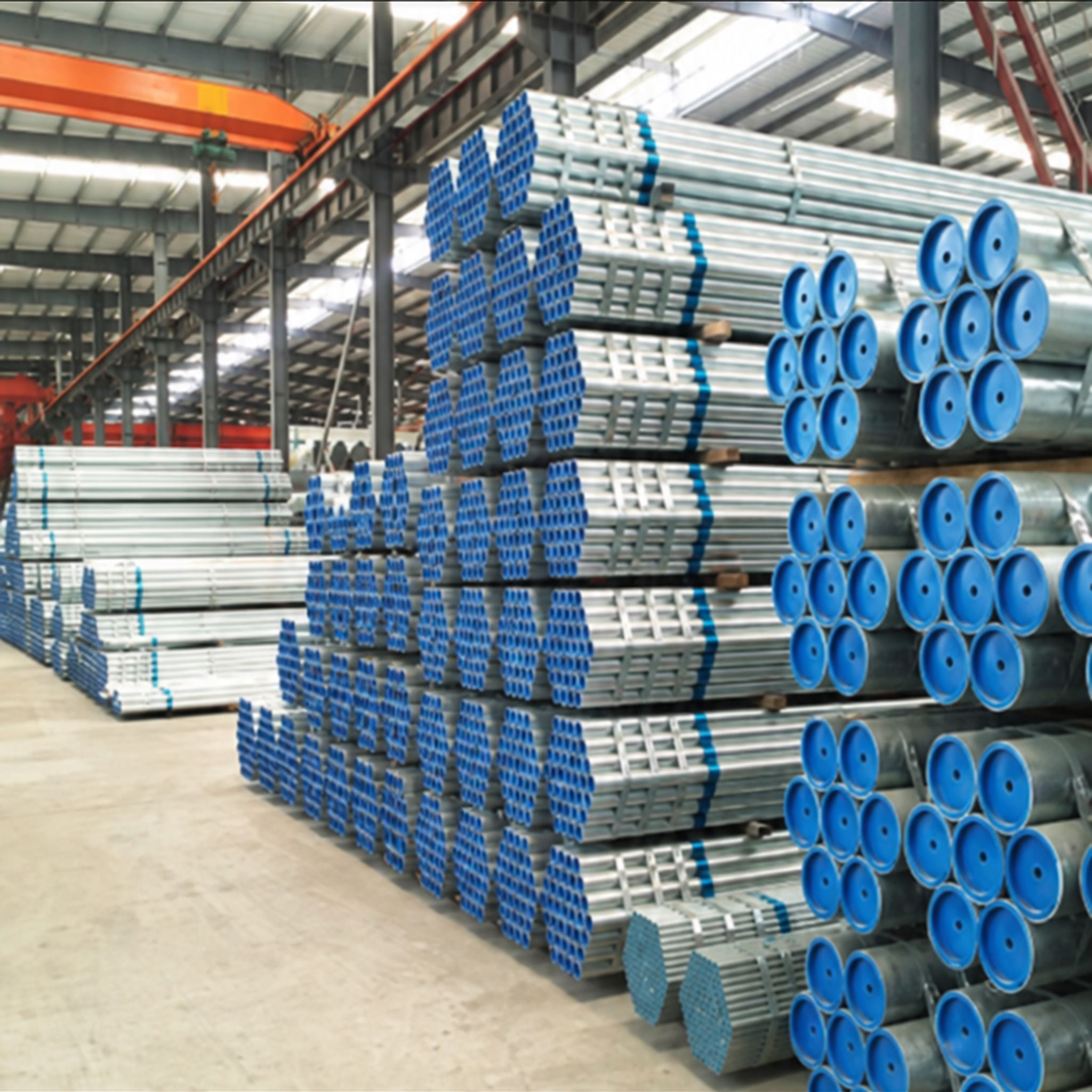
Galvanized tube on the market follows two routes, and choosing between them is the first specification decision most buyers make. Picking the wrong route usually shows up later as either paying for coating you do not need — or receiving tube that corrodes early in a demanding environment.
This guide explains how each route works, where each fits, and what to write in your enquiry so your supplier quotes the right product the first time.
Two processes, in one paragraph each
Hot-dip galvanized (HDG) tube is formed first, then dipped into a bath of molten zinc. The result is a thick coating — typically several hundred g/m² — with a characteristic crystalline “spangle” finish. This is the route used for water lines, fire-protection piping and heavy structural work, where project standards often call for post-galvanized coating weights.
Galvanized tube starts as steel strip that is zinc-coated at the mill before forming. The tube is roll-formed and welded from that coated strip, so the is specified directly as a coating weight — standard production covers Z40/Z60/Z80 (40/60/80 g/m²) — lighter and very uniform on flat surfaces. This is the industry workhorse for fabrication work: furniture frames, fencing, greenhouse structures, racking and general light fabrication.
Matching the route to the job
| Your use case | Better fit | Why |
|---|---|---|
| Furniture frames, racking, gates | Galvanized | Clean surface, tight dimensional control, takes powder coating well |
| Fencing, guardrails, greenhouse structures | Galvanized | Cost-effective corrosion protection for outdoor fabrication |
| Clothes-drying racks, fitness equipment | Galvanized | Uniform coating is ideal for electrophoretic or powder finishing |
| Pressurized water lines, fire protection | HDG (per standard) | Standards typically require thick post-galvanized coatings |
| Heavy structural work per project standard | HDG (per standard) | Coating weight requirements exceed galvanized classes |
A note on fit: galvanized coating classes are designed for fabrication and light-structure uses. If your project standard specifies a thick post-galvanized coating, ask your supplier to confirm the coating weight in writing before you order — a reputable supplier will tell you honestly whether they can meet it.
What to put in your enquiry
- Intended use and environment (indoor, outdoor, coastal)
- Profile and size: round OD, or square/rectangular section and wall thickness
- Length and quantity
- Coating class if specified — or ask your supplier to propose one
- Destination port, so freight and packing can be quoted
FAQ
Is galvanized coating enough for outdoor use? For fencing, greenhouses, racking and similar applications, Z-class coatings are the industry standard choice. For coastal or highly corrosive environments, discuss the coating class with your supplier before ordering.
Can galvanized tube be powder-coated? Yes — the uniform, thinner coating and clean surface are exactly why fabricators prefer it for visible furniture and fitness-equipment frames.
Do you produce hot-dip galvanized tube? Yuanheng rolls pre-galvanized tube — round, square and rectangular — in walls from 0.6 to 2.5 mm with Z40/Z60/Z80 (40/60/80 g/m²) coating, from 1-ton lots, at its Jiangsu base. If your application needs a heavy post-galvanized coating, send us the requirement and we will confirm feasibility honestly before quoting.
Need a specification priced? Send your profile, sizes, wall and coating grade — we reply with feasibility, pricing and a delivery schedule. Contact Yuanheng →